Showing posts with label Book Review. Show all posts

Thursday, 1 March 2012

Metro 2033: Science Fantasy or Fiction?


Hello, um, Blogger.

It seems it has been since 2010 that I last wrote anything here? Well - I am, as it were, back in the saddle. My thesis proper is finished long since, and accepted with good grades and so on, and now I am in fact doing research in this very same field of literature! Isn't that exciting? This means I've a reason to write something in these here blog again, so I hope to be doing that a bit more frequently now. We'll see if the ratio of entertainment-academia becomes slightly more skewed towards the former or not - chances are they might?

Anyway, the purpose of this post is to approach/discuss the Dmitry Glukhovsky novel Metro 2033. Unfortunately this particular piece of Russian writing won't be a part of my eventual doctoral thesis since it's a translation, so my thoughts on it will largely be rambling rather than proper reviewing. Also, it's rife with spoilers, so if you want to avoid that, don't read I guess? It's a good book and I can recommend it, although the translation is spotty to say the least.

So: the premise is that somewhere around 2013 or so, a global nuclear war (the reasons for which are never discussed) devastates the Earth. Luckily for the Muscovites, the Moscow metro system is also the world's largest nuclear fallout shelter, and it is to it and its myriad tunnels and stations that the survivors flee. A decade or two later, people are still living underground, in societies formed along station or line boundaries or according to ideologies. The survivors' diet consists mainly of mushrooms and pigs that eat mushrooms.

The secondary premise is that the metro dwellers must remain such. The surface has become uninhabitably lethal. Aside from the radiation and the blinding sunlight, the surface is now home to mutated creatures, many of which it seems do not even have an equivalent animal it mutated from (such as the Librarians, unless they're mutated humans I suppose). What more, and this is even touched upon at some point, the rate of mutation makes little sense - it's difficult to imagine the kinds of monsters found on the surface could appear in scarcely a decade, not to mention the monstrosity in the Kremlin. Or, indeed, the Dark Ones themselves, the instigators of the whole plot of the novel.

The Dark Ones are not a part of the premise, exactly, seeing as they ultimately only appear a few times. They start our protagonist's journey through a task given to him by a member of a mysterious group, Hunter, dedicated to the preservation of the Metro. Artyom must travel to the centre of the Metro, Polis, in order to warn Hunter's superior about the threat of the Dark Ones, and so that they may find some way for his station to combat the encroaching monsters. Artyom, as befitting of a blank slate protagonist, obviously knows little of the Metro outside of his station, and is thus the perfect set of ears and eyes for the reader to experience it all through.

And that's what this book is essentially about: discovering the underground world of the Metro, with all its varied types of survivors, ideas, ideologies and mysteries. And they abound, oh yes: Glukhovsky, were I to use him in my thesis, fits very neatly into the definition I have made of post-postmodern writing. The novel's more than aware of the fact that fiction is fictitious, but it does not flaunt it like postmodern texts did (except in one particularly memorable dialogue towards the end, but that was a bit of authorial indulgence I had no trouble swallowing): rather it neatly incorporates the inexplicable and the supernatural into the general mood of the story. From the very first pages, we realize that Metro 2033 is a two-layered thing, where what is 'real' and what is just stories is constantly in question.

We gain access to most of the Metro via stories told to Artyom, starting from the very first pages, stories about other stations and lines, some grounded in reality while others are more fantastic. We (the readers) in turn experience the Metro through Artyom as he travels it, alternately finding that reality is not as fantastic as we were told, and alternately finding it is even more fantastic. This technique is not in itself something unique, but the layers of 'reality' versus 'superstition' effectively become so blurred it is entirely up to the readers sense of willing suspension of disbelief (please see my previous entry on Coleridge et al.!) whether or not they end up 'buying' the world of Metro 2033. Of course, 'buying' the world itself is what largely determines how effective the novel will be.

This brings us to the point of all this: where does Metro 2033 fit in on the arbitrary scale of science fiction rationality versus the kind of fantasy typically found in magical realism? I admit that I myself had actually played the game before I read the book, and I was therefore surprisingly enough prepared for the supernatural elements when they arrived (surprisingly because game narratives rarely follow their sources very closely), but I'm not sure how I would have reacted without prior knowledge of them. Probably with inquisitiveness: how do hypnotic voices emanating from pipes or stretches of tunnel with deadly effects on the human mind fit into the overall picture of ragged survival and very human conflict? Luckily, this same inquisitiveness is what Artyom feels, so our journeys happily coincide - what more, his companions are more than willing to provide their own interpretations of events, which either muddles or clarifies the issue, depending on how you wish to view it.

This duality is perhaps best presented through an event in the novel itself. Towards the last third of the book, when Artyom finally reaches Polis, Artyom has just experienced the memorable piece of dialogue I mentioned earlier. This happens on the station just before Polis, where he meets two hookah-smoking gentlemen who engage him in conversation. Allow me to reproduce a short extract from it:

"But do you believe in fate?" asked Sergei Andreyevich, inclining his head to the side and examining Artyom studiously, while Yevgeniy Dmitrievich turned away from the hookah with interest.
"No," said Artyom decisively. "There is no fate, just random events that happen to us, and then we make things up on our own later."
"Too bad, too bad..." sighed Sergei Andreyevich disappointedly, austerely looking at Artyom over his eyeglasses. "Now, I'm going to present a little theory of mine to you, and you see for yourself if it matches your life or not. It seems to me that life, of course, is an empty joke, and that there's no purpose to it at all, and that there's no fate, which is to say anything explicit and definite, along the lines of you're born and you already know that you're going to be a cosmonaut or a ballerina or that you'll die in your infancy...No, not like that. While you're living your allotted time...how do I explain this...It may happen that something happens to you that forces you to perform specific actions and make specific decisions, keeping in mind you have free will, and can do this or that. But if you make the right decision, then the things that happen to you subsequently are no longer just random, to use your word, events. They are caused by the choices you made. [...] And your life will gradually stop being just a collection of random events; it will turn into....a plot, I suppose, where everything is connected by some logical, though not necessarily straight, links. And that will be your fate.
(Metro 2033: 254-255)

Strengthened by the realization that the incredible events leading up to this point in his journey (that is to say, the plot of the novel) indeed constitute the plot of his life (hello, postmodernism), Artyom hurries on. However, in Polis, the description of the two gentlemen he spoke with earlier causes a different reaction. There are two factions in the station, one scholarly and one military. Both contend that the station through which Artyom passed and where he met Sergei Andreyevich and Yevgeniy Dmitrievich is in fact empty and uninhabitable. The military claim that people often experience hallucinations while there due to a gas leak, whereas the scholars come to believe people who see and speak with someone while there are special and chosen. This very neatly puts the ball in the reader's court: do we believe the military (it was just a gas leak, causing Artyom to hallucinate the whole conversation) or the scholars (it was exactly what it seemed to be; a bit of otherwordly providence, showing Artyom how special and unique he is to the plot of the Metro). Artyom himself is troubled, but Glukhovsky does not provide a definite answer either way, although he allows for both.

The one piece of suspension of disbelief we do have to accept, even if we go in for the harder science fiction route, is that mind control or telepathy or psionics what-have-you is now officially possible, potentially through the effects of a powerful experimental bioweapon released on Moscow during the war (which, in turn, might also be the reason behind the improbable monsters on the surface). This ability is particularly apparent towards the end, when they meet the worshippers of the Great Worm, who turn out to have a few capable telepaths among their numbers. Another example is the Kremlin and its inhabitants: demons or merely monstrous mutations? Once it is established that the human mind can now be affected in this way, by whatever means it is accomplished, one can easily explain most of the bizarre occurrences in the Metro by ways of this. Perhaps there are simply other creatures like the monster in the basement of the Kremlin who are capable of controlling minds, and these live here and there, preying on lone wanderers in dark tunnels.

Or, then we allow for the preternatural, in which case Metro 2033 is an interesting amalgam of the post-apocalyptic science fictional genre and horror writing, possibly set in the kind of world these guys are creating, where the bizarre and memetic exists just underneath and hidden away from the surface normality - except, of course, that in the Metro, it has all come bursting out of the woodworks following the nuclear apocalypse.

Being a post-postmodern reader myself, I accept both interpretations as equally valid. The rational, science fictional interpretation is canon, the one I would use if I were to be transported bodily into the world of the text and had to 'explain' what was going on. The other interpretation is the super- or metatextual one, the one that self-consciously uses the text to talk about issues outside the text or then about the text itself in relation to other texts. A metaphor, a comment, another layer. And read so, Metro 2033 is, to say the least, very enjoyable.

The translation is still incredibly spotty though, or at least it feels like it is. Yikes.


Glukhovsky, Dmitry. 2007. Metro 2033. London: Gollancz.

Tuesday, 14 September 2010

On The Beach

Nevil Shute's On the beach (1957) is different. Very different. Perhaps the world it portrayed – one where Australia (and indeed the whole southern hemisphere) has narrowly escaped nuclear annihilation, only to succumb months later to the radioactive winds blowing in from the northern hemisphere – is what makes it so different. On the beach is post-apocalyptic in every sense of the word, except for the fact that the society described (mainly Australia) is in no way descending into barbarism and chaos: rather they are accepting of their fate, to various degrees, and life goes on to the very end. T.S Eliot's famous quote, which also adorns the title page is apt: “This is the way the world ends. Not with a bang, but a whimper”.

It made me think of the ad-hoc difference made between “plot” and “setting”, as if these two things were somehow divisible: the plot was good but the setting boring, or the setting was compelling and interesting but the plot was bland. It seems to me that what makes post-apocalyptic novels stand out is that the setting very often IS the plot. As I wrote in my post on the chronotope, the post-apocalyptic world is one that is re-discovered, as in a travelogue, and no-one would demand a travelogue to have a plot beyond the descriptive: “I came from here and went there and saw this”. In On the beach, the setting is one of a still-living and breathing Australia waiting for the inevitable, together with the submerged scouting trips by the last operational US submarine Scorpion all along the United States coastline which allows for a glance into what will soon be true in all the world.

The plot then, naturally, is 'merely' the lives, thoughts and feelings of those still alive to witness this – in particular the burgeoning but never consummated love affair between Commander Dwight Towers and Moira Davidsson, Peter Holmes and his slightly delusional wife and their newborn baby daughter Jennifer, and the egghead John Osbourne with his Ferrari and newfound passion for racing. Each tells a slightly different and quite compelling version of how to cope with the whimpering end of the world. Perhaps the only thing marring this setting and plot is the hunch I have that radiation would not work in the way Shute describes it, notwithstanding any potential 'cobalt' bombs used – the lethal fallout would have rained down and disappeared long before reaching Australia, and even if not it would have been rendered mostly harmless in 15 months time. The real problems, it seems to me, would be the unimaginable social turmoil brought on by such a war, the collapse of industry and most probable the inevitable famine and unstoppable mass of refugees from the areas of conflict. Although Shute addresses the issue of petroleum no longer being available, in the book it is truly a minor problem: trains and electric-powered trams, together with bikes and horse-drawn carriages can apparently completely replace fuel driven transport with nary a hitch. Likewise, until the very, very end (as in a few days until the radiation arrives), there is no sign of normal day-to-day business changing at all: people still show up at work, buy and sell things, plan their gardens and otherwise go about their lives, despite (or perhaps because of) the inevitability of their demise. It's a testament to Shute's skill as a novelist that he manages to pull it off.

Because he does, he really does. On the beach is a quiet, contemplative, incredibly solemn view of the post-nuclear holocaust. We are left with the image of empty houses in the morning air, completely untouched, bathed in the deadly, invisible and incomprehensible new threat to all life on earth that had been unleashed just slightly more than a decade before Shute's book was published. A new kind of sublime for our age, the nuclear sublime.

Of course, the nuclear sublime is now receding, and what comes next...well...that'll be for my thesis to find out, maybe?

Monday, 16 August 2010

The Art of the Evident

Margaret Atwood's two recent forays into the world of post-apocalyptic/dystopian literature is, I think, a successful one. Although I would say that something in the environs of 80% of both novels concern the dystopian, near-future world destined to destroy itself, the apocalypse itself (and the post-apocalypse) is such an important event that everything else in the novels is informed by it (meaning I can discuss them as specifically 'post-apocalyptic' novels).

The below is fantastically spoilerific, and the novels themselves quite good, so I really, really recommend not reading this unless you enjoy spoiling the story.

Oryx and Crake (2007) is the first novel in the series. It begins quite powerfully, describing all the necessary elements of Atwood's fantastical world in a single chapter: a man calling himself Snowman lives in a tree on the scraps of yesterday, his only companions odd, created humans ('Crakers') to whom he functions as a sort of prophet or demi-god. We are given an idea of the pre-apocalyptic world first through the brand/company names: BlyssPluss, ChickieNobs, AnooYoo, HelthWyzer, HappiCuppa, and so on. A hyper-consumerist-capitalist society, in other words. We also learn, very soon, that almost all natural species of our world have long gone extinct, replaced by lab-grown gene splices, including a particularly nasty species of giant pig, called a Pigoon – by virtue of being like a balloon in size. Visible from the beach, the towers of some city that was caught in the rising waters of global warming is now only home to sea birds. The environment is harsh, there are daily storms and the sun's rays are more harmful than not, suggesting a hole in the ozone layer. A hyper-consumerist-capitalist, morally bankrupt, god-complexed society. If it weren't for the abject misery of the Snowman, the reader is probably already happy that the old was swept away.

The story then turns to the Snowman's childhood – or, more precisely, Jimmy's childhood. It is told in a precognitive manner, with constant references to the future, which gives it an almost breathless feeling. Now we are truly immersed into the dystopian, pre-apocalyptic world of Atwood's. Jimmy is a 'compound brat', a child living within the safety and comfort of corporate-run compounds, surrounded by walls and safeguarded by the sinister CorpSeCorps (yes, “Corpse Corps” - the art of the evident in action). Jimmy's father is involved in the creation of the Pigoons, as well as many other gene-spliced animals, including Jimmy's own rakunk (raccoon-skunk) he names Killer. His mother, on the other hand, seems to have once been a top scientist, but now spends most of her time at home smoking too much and generally not living up to the American Dream. She is a subversive, a person who has realized the utter corruptness of the system, and has decided to escape it (which she eventually does, an act that haunts Jimmy for almost the rest of his life).

Contrasted with the compounds are the “pleeblands” - where regular people live, except that it is assumed the pleebs are filled with diseases, poverty and crime (and nothing in either book seems to suggest otherwise). The pleebs – once again, she couldn't be more obvious in her naming – are us, the rabid consumers who fund the whole corporate horror culture, swallow their slogans whole, and generally act exactly like 'they' want us to act. To drive the point home as cleanly as possible, Atwood has replaced the government, the army, the police; everything, with the CorpSeCorps (Corporate Security Corporation; alternatively Corps as in the Marine Corps). Ostensibly, they are there to protect the corporations as a private security contractor, but in reality they control everything in the same way Big Brother controlled everything in 1984: through violence and surveillance.

Using classic storytelling techniques, Atwood tells two tales at the same time (the post- and the pre-apocalyptic ones), with the same protagonist. As time goes on, the two timelines close in, and soon we are reading about how Jimmy survived the man-made apocalypse, rescued the 'Crakers', and ended up naked and alone in a tree by the beach. The two characters in the title, Oryx and Crake, are there for a reason: Jimmy is, after all, just the eyes, ears and mouth of the reader-author, since he is mostly incapable of actually doing anything, instead merely observing and following the flow. Crake is his one and only friend, a boy-genius who grows up with an intense dislike for the human race as a whole and a desire to, in short, replace it with a wholly new one. These are the Crakers that he creates, with a long range of characteristics, habits and so on that would, in his eyes, eliminate the destructive tendencies in human nature (the most oft-cited example of these changes being seasonal mating, coupled with a 'group sex' kind of tradition in which there can be no obvious father, and therefore no obvious family units). Sex is also the way he goes about ending the human race, by creating a pill called “BlyssPluss”, a sort of super-viagra that is apparently irresistible to any who try it. He spreads it across the whole world, and they begin the pandemic which in a few short weeks wipes out almost everything and everyone. Oryx, on the other hand, is the one person who can make Jimmy act (through his love for her), which he does, at the very end when he kills Crake for killing her. It may be noted that it was never really explained why things went down the way they did in the end, but perhaps Crake had it planned all along: kill her, have Jimmy kill him, then have Jimmy lead the Crakers to safety, and then let Jimmy die (since the Snowman, although Abominable, is also quite a hopeless survivalist).

The second novel, The Year of the Flood, concern a different, but interconnected set of people in the same world – in the same city even – as Jimmy, Crake and Oryx. The two main characters, Toby and Ren, are both members of a sect called God's Gardeners, who were also mentioned in Oryx and Crake. The Gardeners believe in the imminent coming of the Waterless Flood, which will wipe away all but the faithful. Their belief is a fascinating mix of new age eco-green thinking and modern-day scientific Christianity, and their thoughts take almost complete control over the characters in the novel: each chapter, more or less, begins with “The Gardeners used to say...” or “Adam One used to say...” (Adam One being the leader of the sect). Although there are plenty of rather frightening aspects to the cult, as there must be, it does seem like Adam One, the founder and leader, really is as sincere as he appears to be. Once again, the novel mostly concerns itself with the childhood and adulthood of the characters involved, including B(Ren)da, the childhood sweetheart of Jimmy, but this time the past and the present (pre- and post-apocalypse) seem to come together much more strongly. The children they grew up with return as adults, the survival skills they learnt are put to use, their creeds, holy days and traditions are used as a basis of a new culture, and their old enemies still stalk the new wilderness. It may be noted that Oryx and Crake ended in a cliffhanger, a cliffhanger that is finally resolved in The Year of the Flood, in quite a masterful manner. Atwood also goes deeper into the world she created, seeing as all her characters are now pleebrats instead of compound children. The pleebs, it seems, really are as dangerous and inhospitable as the people in the compounds believe, unless you find yourself inside a corporate stronghold of some kind, which both Toby and Ren do. I do not believe this novel can be read without first reading Oryx and Crake (or reading it afterwards – either way, both are needed for the full picture) – there are plenty of events, characters and groupings that only really make sense after reading both novels.

I called this essay (post?) 'The Art of the Evident', because that is the strongest impression I got from reading Atwood's work. From the fanciful product names to the endless lists of never-explained-but-clearly-immoral jargon, Atwood's dystopia is a frightfully obvious vision of all that can and will go wrong in the world if we allow it to continue in its current downward spiral. Everything she does or writes just piles it on higher. Instead of real leather, they have 'fleather'. Instead of real hair, they have 'Mo'Hair', the result of a gene-spliced lamb of some kind. Instead of animal meat, they have soy-everything. Except, of course, the ones who do want 'animal protein', who will eat endangered species to get it – or why not the ones who are so desperate for an animal protein burger they'll buy a SecretBurger (the 'secret' meat being so ridiculously thinly veiled that it's not even a veil, really). The HappiCuppa franchise is really just Starbucks, except even nastier on the rainforests (supposedly). HelthWyzer first makes you sick with their pills, and then make tons of money off the treatment. ChickieNobs are chicken muscles grown on sticks – 'no brain, no pain', although that too might just be marketing rather than truth. There are religious groups like the “Known Fruits” or the “PetroBaptists” which consists of, well... Hell. A name like “Petrobaptist” is pretty much about as in-your-face as you can get! It is all very, very 1984, except of course it has been updated to 2012-standards instead. The final obvious thing is of course that it was all coming to an end -anyway-, even without Crake's specifically engineered plague: generally when we read a contemporary post-apocalypse, the end seems neither inevitable nor desirable (since we live in it), whereas in Atwood's novel, it is both.

I would not claim post-apocalyptic fiction is subtle most of the time. You take an inconceivably terrible event of some kind, which brings an end to the-world-as-we-know-it, and then you putter about the aftermath, bringing to fore this or that aspect of the world we left behind (often discussing in length the causes of the apocalypse and ways to prevent it). Survivors, as I explained in an earlier post, is particularly flagrant about this, but all post-apocalyptic works enjoy their own special brand of pathos. This is probably why we like reading them, after all! Atwood, however, takes this lack of subtlety to a new level. She creates a whole world, run by short-sighted idiots, and then she kills it through the self-same methods that allowed said idiots to run it. She does it through amazingly skilled prose, believable characters, fantasy-author level and beyond world building (this is meant as a compliment), and a great storyline. Make no mistake, they're eminently readable and enjoyable books.

But they are also pastiches. There is a certain point up to which you may write about evil corporations taking over the world before it becomes vaguely ludicrous (that point is crossed when they're called “Corpse Corps”). The horror/wonder of genetic modification can be discussed up to a certain extent, and then it just crosses over into “what the hell” land (Lamb-Lion splices for religious purposes is pretty much up there). The disparity between the rich and the poor, the well-educated and the “plebs” can be discussed at some length, but there has to be some leeway for regular, normal people as well (this point is crossed when every single feature of the 'pleeblands' is described as if from the eyes of someone who's watched 24/7 news coverage of gang warfare in the inner city and has extrapolated this to encompass everything that is not within a compound). Atwood's Earth is a living, breathing world, teetering on the edge of oblivion, and the fact she managed to pull that off is a testament to her skill as a writer. That notwithstanding, it ends up reading like a Kilgore Trout story delivered straight (or, as if Kilgore Trout was suddenly given the ability to write good prose, instead of just coming up with good ideas). Kilgore Trout, of course, being Kurt Vonnegut's famous science fiction writer, who in turn is modelled after Theodore Sturgeon.

I'm not so sure, though, that it is a pastiche of a post-apocalyptic novel. In fact, the post-apocalypse is every bit as serious and gritty as any other described. This pastiche/parody/over-the-topness is more a feature of the pre-apocalyptic world, her dystopian vision. Atwood's book asks us to consider the environment, consumerism, endangered species and genetic modification, and gives us a hypothetical and somewhat exaggerated extrapolation of what might happen if we continue following the trends she's perceived in the world. I wonder if this may be that can be termed a post-post modern book as well, and if it is in that case one of the first post-post modern works of post-apocalyptic fiction (I'd love to say post-post apocalyptic, but that might be reserved for book three ;). A fascinating, if very different, breed of books, nonetheless.

Tuesday, 10 August 2010

A Slew of Post-Apocalyptic Classics

Recently, I have caught up on my post-apocalyptic novel reading, and have finished a number of old classics as well as more recent works in the genre, and thought I might as well write down my most immediate impressions of them, and how they 'handle' the whole concept of the post-apocalyptic. What makes many of these different from the traditional 'nuclear apocalypse' is of course that only one of them (A Canticle for Leibowitz) in fact concerns itself with that particular Armageddon scenario.

Without further ado, here are the novels (oh, and: huge spoiler alert, so don't read unless you want to):

Survivors by Terry Nation (1976)


This is the book that inspired the eponymous TV-series (according to the inside flap – Wikipedia says the novel was written based on the series; chicken and the egg anyone?), which I haven't seen but which is without a doubt very good. The novel itself, I must say, is not perhaps my idea of high literature, even when compared to some of the other science fiction novels in the genre (notably The Death of Grass). In Survivors, almost everyone is wiped out suddenly by what is essentially the Black Death, except the survivors simply label it “the 'Death'” - a flu-like disease which, after an initial six day incubation period very swiftly leads to the demise of 99.99% (or some such ridiculous number quoted by one of the doctors) of the infected. The few thousands remaining must survive on scavenging and, eventually, rediscover agriculture and toolmaking. A group mentality is born, where some simply band together to farm, whereas others band together to loot, or to rule over the farmers – essentially returning to a feudal type society where a strong-armed baron rules over hamlets or individual farmhouses. Finally, in a move reminiscent of The Last Man, Abby and her group decide that the British winters simply cannot sustain life, and they decide to move south towards the 'cradle of civilization' where winters are milder and life less harsh.

What can be said of the book? It is, I believe, a case of classic science fiction extrapolation almost getting out of hand. Through a series of increasingly unlikely encounters, we the readers are introduced a varying bunch of factions formed directly after the apocalypse. Early on, for instance, Abby meets the founding members of the National Unity Force, which eventually turns into a classic robber baron-type organization, levying taxes, laying claim to loot, and even imposing conscription on those it arbitrarily considers to be within its jurisdiction. In another encounter, we are given a brief look at a man named Garland, the fourth son of an earl, and a textbook example of a 19th century adventurer, up until then a relic. Capable, tough, forever gallant and above all relishing every moment of the post-apocalypse, he's either a sociopath or just someone who realizes he's found his niche at last. Garland wishes to reclaim his family's mansion and rule those around like a benevolent dictator, and is participating in a sort of guerilla/Robin Hood campaign against the 'squatters' who have taken up residence there to do so. Although the only real action hero in the novel, Garland is killed off-stage from something as unheroic as a gangrenous wound. Various other encounters also give us a glimpse into Nation's perceived version of post-apocalyptic Britain, including a travelling band of scavenger-traders, operating out of Birmingham, which attempted to reinstate the gold standard, and a group of boatsmen near Dover that ferry the willing across the channel to France in return for food and petrol (although these might very well have been swindlers).


The philosophical side of the apocalypse is also explored, almost immediately and with about as much subtlety as the political/social landscape mapped above. The main philosophy, which is, Abby's view that the survivors cannot rely on scavenging and using up the materials of the old world, but must rather endeavour to rediscover old techniques, both for farming and for making tools and such, is contrasted with the short-term goals of looters and tough guys like the NUF, who are content with living off the remnants all around. The decision for the exodus to France, for instance, is prompted by Abby's realization that they simply haven't the time or manpower to do anything except plant the bare minimum for survival every year – which will eventually lead to their tools and equipment breaking down, without them ever having had the time to relearn how to make them. The unsubtle criticism of modern day man's ineptness is all around, including an early encounter with an older professor sporting a hearing aid with only two more batteries, who asked Abby if she knew how to make something as relatively simple as a candle or a glass decanter.

In short, Survivors is a survivalist fantasy first and foremost, concerned with the rediscovery of 'old' skills and a gradual return to a simpler, agrarian society, which is nonetheless frustrated by the ambitions of men with guns wishing to wage war (a word often thrown around, both regarding the NUF and Garland's skirmishes). Although it is bleak, it is never hopeless, especially as the core group around Abby shows itself to be uniformly made out of 'good guys' (with the possible exception of Tom Price). Nation only scratches the surface of the psychological and emotional side of things, preferring to stick solely to practical topics – perhaps a good way of going about it for a TV series, where the actors and the director can provide an emotional outlet, rather than the text itself. Unfortunately though, although there is plenty of drama and excitement, the novel reads more like a textbook on practical post-apocalyptic survival than as a story about humanity struggling to cope (socially, psychologically) with its new surroundings.


The Death of Grass by John Christopher (1956)


This is essentially a long short story, or a novella, or some other such appellation, seeing as it's not a very big work. I wanted to jot down my thoughts on it right after Survivors, since much like Nation's novel, this one too is set in Britain. Christopher's apocalypse comes in the form of a virus that specifically targets cereals – wheat, grain, rice. Much like in Survivors, the pre-apocalypse is a time of propaganda and attempts to avoid widespread panic, but the main characters (John Custance, Roger Buckley and gunshop-owner Pirrie with families) soon realize where things are going: very soon, food stores will run dry, and life will become a desperate struggle to find food. Unlike Survivors, however, there is no 'Death' on a massive scale: everyone is at least initially still alive. Since we can't have a post-apocalyptic survival tale featuring millions of people walking the roads, Christopher solves the 'problem of too many people' by having the government threaten to launch nuclear bombs on all major cities to curtail the population (which, I believe, does not ultimately happen). In a curious twist, it is in fact these hordes of soon-to-be ravenous people who are the main 'threat' in the novel, and essentially what Custance and his band are pre-emptively escaping. Of course, they're not the only who got that the idea, and they soon meet all the other roving gangs in anarchy-stricken Britain. Their goal is an isolated and easily defensible plot of farmland, set between a rapidly coursing river and unassailable mountains, which is tended by John's brother. On the way they pick up some survivors, leave others behind, kill to defend themselves and kill to eat and above all begin to lose most layers of basic human decency in a cavalcade of “it was us or them” justifications.


The story itself is a lot more contained than Survivors, in that it only details a single journey across the land, rather than years of agriculture, childbirth etc., which might be one reason for it being more compelling as well. But the main reason, perhaps, why The Death of Grass is so captivating lies in the fact that our heroes aren't the good guys. They are, in fact, looters. They are, in fact, a band of armed men who will do whatever it takes to survive – and not only that, they will also justify it. In the end, it is revealed that John's brother has (predictably) already found a likeminded group, who have already moved in and fortified the farm. The brother is willing to let John and his family enter, on the condition the rest of John's band is left outside. Rather than keeping with filial loyalty, John doublecrosses and kills his brother and the gang he lives with, and moves in in his stead. 'It was us or them'. Much of this 'evil' influence comes from Pirrie, who is in many ways a sociopath of the Garland type – a person who relishes in the newfound freedom of the post-apocalypse, except he does not hold on to any old chivalric ideals. Instead, he kills his hateful wife the first chance he gets, and then 'claims' a younger girl for his own at a later point. Yet his usefulness and skill with the rifle makes him indispensable. Despite allowing all of this to happen (or in some cases making it happen), the reader cannot help but root for Custance and his band. Perhaps this is due to the nature of the apocalypse: where else is the mentality of eat or be eaten clearer than when it comes to the bare necessity of procuring food? Any other type of apocalypse would, first of all, have killed off most of the populace, and second of all, left traditional food crops unscathed – in this version, all that remains are potatoes and too many mouths to feed.


Philosophically, the apocalypse (much like Survivors) brings out old, nasty traditions. The women are relegated to second-tier citizens almostinstantly, and in some cases (as detailed above) literally become goods that can be claimed. The men, on the other hand, very quickly place themselves into a pecking order, with John Custance and Pirrie on top. In one memorable scene, they meet another group of armed men, and John suggests they team up for security. The leader of the other pack, however, wishes to stay top dog – and Pirrie shoots him down with no remorse. Afterwards, all the men of the other group pile in to shake hands with John, and almost immediately begin calling him “Mr. Custance” - only a step below 'Lord' or 'Sir'. This theme of leadership is one the two novels share, and the implication seems to be that as long as the chosen leader is strong, the group will thrive. Although John initially thinks of his role as leader as only temporary, by the time they gain their stronghold, he is sure that his children will become rulers after him, in an unprecedented return to old system of inheritance.


The Death of Grass is not a survivalist book in the same way as Nations' novel, as it does not concern itself with the truly long term, or with any organizations or the like that might form. Rather it is an exploration of exactly how swiftly and ruthlessly 'civilized behaviour' evaporates in the face of the apocalypse, and of the elements that replace it: tribalism, nepotism, survival of the fittest. Refreshingly, our heroes aren't the 'good guys' who watch as others devolve, but rather just a group of survivors among others, looking out for their own. The text is minimalistic, and much is left to the reader's imagination, but in my view it works very well. It is terse and sometimes terrifying, and highly recommended.

I Am Legend by Richard Matheson (1954)


For once a novel wherein I've watched a movie adaptation (I say 'a' since there are many) before reading the book (or short story). The movie in question was the recent Will Smith flick, and I can honestly say that although the movie was a beautiful rendition of post-apocalyptic, post-human New York, it didn't really have anything to do with Matheson's story.

In I Am Legend, the world has inexplicably been taken over by what appears to be vampires, the living dead. Blood-drinking, repelled by garlic, religious symbols and their own mirror image, and slain by stabbing a stake through their heart or by exposing them to sunlight, they at first truly appear to be the supernatural. Robert Neville believes himself to be the last survivor, and makes do as well as he can in his fortified house, which every night comes under siege by his old neighbours and friends. His life is carefully timetabled, and he fills the daylight hours with equal measures of vampire-killing and scavenging, or doing other tasks around the house, such as securing every opening with garlic. He is particularly tormented, for some reason, by the women, and is apparently of a rather horny disposition, and sleeps poorly at night with the aid of too much alcohol and ear plugs. At first, Neville appears rather self-destructive, breaking things in frustration, sometimes coming close to exposing himself or his home to the vampires. Over time, we are given glimpses into his past, the progress of the disease and the events leading up to his isolation. And Neville also gives himself a reason for existence: finding out what exactly the disease is all about.


This is a very effective technique for a novel of this type, where we only have a single protagonist to worry about, and none other he can interact with (until the end stages of the book). His frustrations and his discoveries slowly make the picture clearer. He finds the bacillus that causes the change, and figures out how it functions. He realizes that some things (such as garlic and sunlight) are (sometimes lethal) allergic reactions, whereas others (such as mirrors and crosses) are merely strong psychosomatic ones. He alsofigures out where the bacillus came from: a result of radioactive mutation, spread through ubiquitous 'dust storms', which in turn are the result of some other, more mysterious calamity suffered earlier (perhaps a nuclear war – referred to as the “bombings” (p.45) that are causing said dust storms). In a way, then, the apocalypse of the vampire plague was caused by human hand as well, if nothing else due to the (apparently global) dust storms. He places a great emphasis on the fact that the whole 'vampire' myth is ultimately only a result of deranged minds, religious fervour and the yellow press.


The one thing Neville does not figure, despite his research, is that some might not be as badly affected as others. The great end twist, which also explains thename of the novel, is that the 'living', non-crazed vampires have found a way to live with the disease, and eventually even thrive (and send a spy, Ruth, to find out more about him). Neville, as the sole surviving 'human', has become a sort of terrifying legend to these people – a day-time hunter who can kill any of them at any time, a terrible scourge upon them possessing mystical powers (i.e., he has become a 'vampire' to the vampires). He is, finally, executed for his 'crimes', albeit these crimes were committed without him being aware of it (although he does become a surprisingly dispassionate person by the end of the novel).


In this novel, like in the two previous ones, the agent causing the apocalypse is not exactly a result of human action, although the connection between the 'bombings' and the mutated bacillus is a fascinating one. The only other thing connecting this to the other novels I've read is that Neville, too, survives on scavenging – except he never has a thought to agriculture, since he is only one man, and has more than enough food to get by. Instead of fear of looters or gangs, he simply fears the monsters gathering outside his door every night. He does worry about his belongings – his generator, for instance – but not that they are stolen, only broken. Although there are several aspects of survivalism in his day-to-day life, Neville is ultimately never in any real danger of the elements. Rather, it is the day-night cycle that controls his life, and which also forces him to stay at one place (although he, unlike his Will Smith movie-self, never seemed to make any particular effort to contact any other potential survivors).


What then is the philosophy of this one? It is a character study, for sure – how does a single man survive in a world surrounded by sub-human monsters? There are the various aspirations and desires of the main protagonist, above all the will to explain the end of the world. That will appeased, Neville seems to be at some kind of peace; until Ruth shatters that. It seems though that even after Ruth's appearance, he still didn't have any desire to truly understand the new vampiric society that had appeared unbeknownst to him. As the title of the book proclaims, he has become a legend, relic of old times, left behind and, finally, exterminated. That, in addition to the bombing-induced dust storms, with a healthy dose of survivalism, seems to be what I Am Legend brings to the table of post-apocalyptic discourse.

A Canticle for Leibowitz by Walter M. Miller Jr. (1959)


This one is perhaps the most difficult of the bunch to categorize and to discuss, since it does not only concern itself about the end of the world and the immediate aftermath, but rather details the post-'Flame Deluge' world's slow and steady rise from the primitive 'darkness' directly following the apocalypse all the way to a rediscovery of atomic energy and the eventual re-destruction of the world. This is all seen through a succession of abbots for the (catholic) monastery dedicated to St. Leibowitz – a saint whose purpose in life was to safeguard the secrets of the old world until the new would be capable of learning from them again.


Although the subject matter here is serious enough, and the events throughout are likewise dire, Miller never lets go of his humorous side. From the description of Brother Francis and his fear of the great demons of Fallout, to the much later domne fighting with his electronic dictation machine and failing miserably, it's hard to read through the whole book without laughing. Considering post-apocalyptic novels tend to lean towards the sad and depressing, it was a bit of a change. That, and survivalism is never a question in this story. The monks of St. Leibowitz go through good times and bad, but as monks, they are perfectly capable of taking care of themselves in a manner all the white-collar British middle class men and women of previous books have been entirely unable to do. That, and the story only actually picks up centuries after the Flame Deluge, when most of the old world has been reduced to rubble and legend.


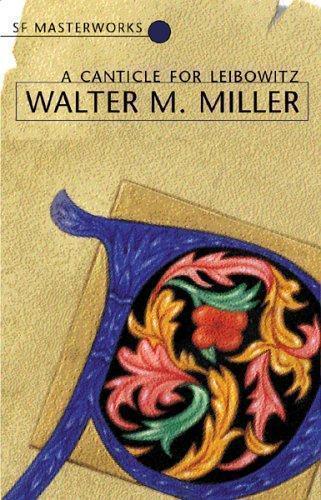
My edition (Orbit, printed 2009) has a cover picture which encapsulates the central tenet of the Order of St. Leibowitz – both its positive and negative sides. The picture is of a shopping list – “Pound pastrami, can kraut, six bagels – bring home for Emma” - except that the P has been beautifully illustrated in the manner of old religious manuscripts, and the rest of the text is written in fancy Gothic lettering. In other words, what the monks do is preserve everything from the old days, often by making endless and meticulous copies of it, without actually understanding the importance or relative unimportance of the texts. In one instance, a brother makes a gilded, illustrated, beautiful copy of a blueprint, retaining the lines and 'squiggles' of the original but adding all the trappings of a medieval manuscript to its margins and wherever he felt it was permissible. The brother, of course, had no idea what the blueprint was actually of, or even what it had been used for, or the fact that the original print as it was was a lot more readable and usable than his illustrated copy. The fact that, when later on a mission to bring both the copy and the original to New Rome, he is robbed, the robbers only take the copy rather than the original points out how skewed the concept of what is valuable and what is not has become.


However, eventually the value of the monk's hoard of knowledge does become apparent, and their musty old libraries are finally visited by the learned men of the new renaissance. Despite some tensions, the purpose of the monks of St. Leibowitz is actually realized, and the narrative shifts to a present-day or perhaps near-future scenario (or far future, perhaps, for Miller). Suddenly, there is the threat of nuclear war again, and soon enough it does come to pass – the total annihilation of the human race once again. This time, however, the church has sent out a space ship to a colony in the stars, containing the whole Memorabilia of the Leibowitzian monks – and thus ensuring the continuation of their mission.


The book goes through too many characters and events and epochs for me to succinctly state what the philosophy of the novel is, aside from what I've discussed above. Miller briefly describes the formation of new kingdoms and realms, of new wars and warlords and bids for power, of religious crises and a technological renaissance. One might ask if it's really a good idea to preserve past knowledge, especially if it's just going to lead to a repeat of the original mistakes. Then again, the monks also preserved the knowledge of the Flame Deluge and warned against that, yet no-one took heed. In other words, a fairly pessimistic outlook. The most powerful image the book leaves is that of a brotherhood of monks keeping the old knowledge alive forever and ever, whether or not they know what it once was for. It is, ultimately, impossible not to sympathize with their task, and hope that some day the circle can be broken.


The circle, incidentally, is something that can no longer exist in modern post-apocalyptic literature, at least not if the writer is astute enough – something I will comment on in Margaret Atwood's Oryx and Crake. The reason is simple: fossil fuels. But that is not something one can assume Miller would have thought of back in 1959.


I will continue with Oryx and Crake by Margaret Atwood in a separate post, and possibly also discuss In The Country of Last Things by Paul Auster and finally Cormac McCarthy's The Road, since I have a feeling these might be the central novels around which I will concentrate my thesis.


Tuesday, 20 April 2010

The Ecological Post-Apocalypse - The World Without Us


A little while ago I read Alan Weisman's wonderful non-fiction book The World Without Us, and thought it'd be interesting to consider it in comparison to its genre. Make no mistake - despite it being a work of popular science rather than prose fiction, it's still essentially post-apocalyptic fiction, even if it skirts around the subject a little. What it gives us is a compelling and well fleshed-out vision of an alternative future that is, nonetheless, based on an entirely fictional and highly unlikely premise. Weisman, in his book, asks the simple question: "What if we all disappeared tomorrow?". Thus, rather than creating a complicated fictional world around typical tropes such as nuclear annihilation, a long-dragged out eco-catastrophe or an asteroid colliding with earth, he can simply observe the world without us. In post-apocalyptic fiction in general, I think this has been a surprisingly uncommon question to ask. Instead of a storyline following a ragged band of human survivors, his storyline follows the ragged remnants of the biodiversity we've left behind, and its struggle to reassert its right to the planet. Like most post-apocalyptic fiction, it's not really about the survivors either, but about the reasons for the apocalypse itself - the challenges the world has to overcome with us gone are all things happening right now. What's fun about Weisman is that the real ecological apocalypse is what will happen UNLESS the premise of his book is fulfilled, which is a nice twist.

It has to be admitted that the book is written like a screenplay for TV; filled with flowering prose it is not. The way he introduces the various characters and events reads like directions to the cameraman (or like Tom Clancy), and much of the text itself could be converted directly to a documentary voiceover. This is perhaps not unsurprising considering Weisman's background as a journalist, and in the context of this book it functions marvellously: the purpose of screenplay prose is, after all, to put images as clearly and succinctly into our heads as possible, and I think The World Without Us manages that just perfectly.

As a resource for anyone wishing to write post-apocalyptic fiction, this book is invaluable. Ever wonder what would happen to skyscrapers, left alone for long enough? At what point all of our largest constructions, from bridges to dams, would begin to crumble? How soon the forests would repopulate the abandoned fields, how the animals would retake their old territories, what would happen to our useless domesticated pets (some of which, happily, aren't quite as useless. Yay, cats!), and how plants imported by humans might affect the end result. Did you, when you wrote your post-apocalyptic world, ever think of what would happen to New York once the pumps stopped working? Or what would happen to the over 400 nuclear power plants when their coolant water finally dried away and the fuel rods were exposed to the air?

Although he theorizes much (with solid, scientific backing, mind), he also visits many locations which are in essence miniature versions of his vision, such as Chernobyl, the Korean DMZ and an absolutely fascinating place in Cyprus called Varosha, which was a beach resort that was abandoned when the country was split in twain in the 1970s, and since then jealously guarded by the Turkish military.

His thoughts on how quickly everything we leave behind would disappear is, to say the least, sobering, as is the descriptions of civilizations that have already disappeared, such as the Mayans. Throughout, his message is clear: ecologically, the human post-apocalypse would indubitably be Eden, and the only things we would leave behind would be our bronze statues and a couple of things we carved into solid bedrock (oh, and a lot of nuclear waste and plastic).

The post-apocalypse is usually a dreary thing, and that is for a reason I believe. We tend to anthropomorphise the world, and if things are going bad for us (people) then things ought to be going bad for everything else as well. I believe this is sometimes referred to as 'pathetic fallacy'. This book essentially proves the opposite. The visions of post-nuclear deserts or ash-ridden skies or eternal winter or whatever scenario the post-apocalyptic imagination can conjure up are all, in the long run, brief seconds in the ever-crunching wheel of life which will, soon enough, retake the earth, with or without us. I don't know about you, but I at least feel a little of the existential blight of the coming end-of-the-world lessen when I think of just how much better off the world will be without us.

On a purely philosophical level, however, I still think it's pretty neat to be able to think, feel, observe and share stuff that happens in this world, so I'm not saying we humans are -completely- defunct in the universal order of things. Just that we really should stop breeding and consuming. Now excuse me while I go back to chewing on chocolate grown on another continent while surfing the Internet on a computer containing bucketloads of petroleum in my nicely centrally heated apartment.

(Picture of Varosia/Varosha taken from here, with licence :

The Apocalyptic Sublime - Reading Shelley's The Last Man


I have variously bumped into the concept of the apocalyptic and post-apocalyptic sublime in the stories I have experienced (e.g. viewed or heard) or read. I have to admit I was not entirely clear on what exactly 'the sublime' meant until I had a chance to read about it properly, but once I did I started seeing it in everything. The first mention of the sublime comes from Longinus, but a more recent and pertinent definition comes from Burke:

"Whatever is fitted in any sort to excite the ideas of pain and danger, that is to say, whatever is in any sort terrible, or is conversant about terrible objects, or operates in a manner analogous to terror, is a source of the sublime; that is, it is productive of the strongest emotion which the mind is capable of feeling." (Burke 1880: 74)


He goes on to describe various images that are sublime, such as towering heights, craggy cliffs, the vast ocean, endless chasms. You get the idea. Kant has a slightly different definition, one which adds the concept of subjectivity to the sublime (i.e. it's not the properties inherent in the external objects that makes something sublime, but the subjective experience of the viewer). In either case, the sublime is "a pleasure that only arises indirectly, being brought about by the feeling of a momentary check to the vital forces followed at once by a discharge all the more powerful." (Kant 1790: 91).

The sublime has a very special, and powerful, place in apocalyptic literature (and film, and video games etc etc). I have recently read a book by Mary Shelley, The Last Man (1826), which details how humanity comes to an end due to a relentless plague epidemic. Beware, spoilers below, although the title of the book itself should be a clue.

In short, this was an awesome read. It's a little fragmented, and in principle consists of three books: the first book details the happy life of the main protagonist, Lionel Verney, and his circle of friends and his family. The second book details a war in Greece, in which one of the main characters, Raymond (a byronic hero) is killed, and whispers of The Plague begin. And finally, in the third part, we enter into the real meat of the story: the detailed description of the fall of man.

This part is quite remarkable, I think, for its ultimately realistic portrayal of the foibles and mad hopes of humankind. The English resolve to head south, away from the cruel winters of their northern climate, and gather what survivors they can. But as they make their way through France, there is in-fighting, and factions form, including a fanatic, power-hungry would-be prophet who attempts to create his own cult in which he may one day be venerated as a deity. On the way they find other survivors; an estranged nobleman riding like a Black Spectre on the road, a little girl found alone in a grand palace, all dressed up with finery playing by herself. Or how about the Swiss girl who plays the organ for her blind parent who is not aware that the end of the world has already occured. Shelley does not mince words:

"Weed-grown fields, desolate towns, the wild approach of riderless horses had now become habitual to my eyes; nay, sights far worse, of the unburied, and human forms which were strewed on the road side, and on the steps of once frequented habitations" (The Last Man: 319)


The most amazing part of the book is the contrast. Shelley unabashedly abuses the typical romantic tropes (well, she can't really be blamed for that, can she?) such as torrential rains and thunderstorms breaking out just as it is the most appropriate, or the fact that Lionel constantly takes refuge in long, melancholy walks through the woods whenever he feels a little under the weather, and that everyone appreciates the beauty of nature and there is nary a single mention of anything that would suggest the industrial revolution.

The first part of the story revolves around royalty; kings and queens and princesses and Lord Protectors. But as the plague sets in, the contrast becomes absolutely palatable. When everyone around him dies little by little, when nature retakes what was once the domain of humans, when all things from art to literature to architecture and history becomes worth less than a single human being. When vain things such as title, rank and heraldry become as nothing, and all men are equal. He sits alone in Rome, the 'capital of the world', and imagines the peoples who have lived there, when he realizes:

"The generations I had conjured up to my fancy, contrasted more strongly with the end of all - the single point in which, as a pyramid, the mighty fabric of society had ended, while I, on the giddy height, saw vacant space around me" (TLM: 369)


In the end, Lionel (with his trusty dog - take that, Mad Max/A Boy And His Dog) ends up a "lone wanderer" (and that's for you, Fallout!), forever to search the earth for another survivor, another soul to alleviate his loneliness. Pathos, but GOOD pathos!

This, I contend, is the right of every post-apocalyptic novel: the pathos of extreme loneliness, the SUBLIME description of the end. Yes, this novel most probably emerged as a result of Shelley's loneliness upon the death of her three children AND her husband, and the estrangement caused by her husband's nasty father and so on, and yes it was probably inspired by contemporary accounts of the plague in various parts of the world, including the Americas (although it was something else there, yellow fever maybe?) - but that just makes it all the more powerful.

I would like, in a much more academic essay, to fruitfully compare this novel to McCarthy's The Road - in particular the idea of 'no redemption' which suffuses McCarthy's novel and which, I think, is echoed in Shelley, as well as the powerful imagery of 'the road' and the discoveries made during travels (this is of course a typical trait of post-apocalyptic novels and films, see for instance John Christopher's The Death of Grass, or why not trailers for the new Denzel Washington-starring movie "The Book of Eli"). Ah, ah, such wonderfulness.

Ahem. Absolutely wonderful book anyway!

Here's where I took the picture on top, titled The Last Man, by John Martin:

[link]

And also, the whole book in electronic format (can also be found on Project Guthenberg):

[link]

Ta-ta for now!

Sources:

Burke, Edmund. 1880. Burke's Works Vol.1. London: George Bell & Sons.

Kant, Immanuel. 1952 [1790]. The Critique of Judgement. Oxford: Oxford University Press.

Shelley, Mary. 2004 [1826]. The Last Man. Ware: Wordsworth Editions Limited.